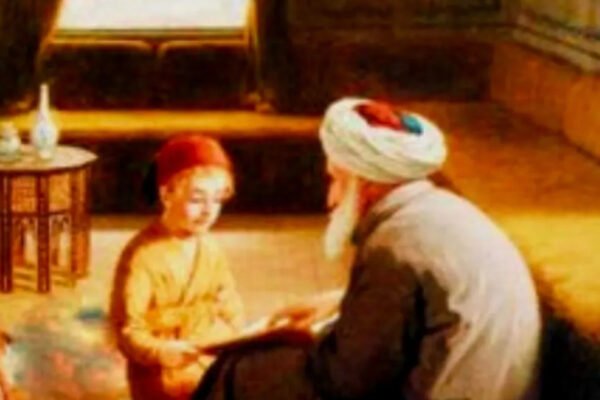

Rumi regarded self-awareness as the core and essence of all knowledge. He saw a person unaware of their own worth and place in the world as blind and foolish — even if they were learned in a hundred sciences and arts.
He writes in the Masnavi:
He knows a thousand chapters of knowledge —
Yet knows nothing of his own soul — the ignorant!
He knows the nature of every substance —
But of his own essence, speaks like a donkey…
And in Fihi Ma Fih, Rumi harshly criticises the proud, foolish scholars of his time through a witty, symbolic tale:
“A king had entrusted his son to a group of scholars who taught him various sciences — astrology, geomancy, and more — until he became a master of all disciplines yet remained utterly foolish.
“One day, the king hid a ring in his fist and asked his son:
“Tell me, what am I holding in my hand?
“The son replied: “It is round, yellow, and hollow.
“Good,” said the king, “Now tell me, what is it?
“The son answered, “It must be a sieve.
“The king sighed: “After all those precise clues that bewilder the minds of men — clues that come from your learned studies — how could you not realise that a sieve could never fit inside a fist?”
“Likewise, the scholars of our time split hairs over abstract knowledge and master what does not concern them — but they remain utterly ignorant of what matters most: themselves.
“They issue verdicts on all things — what is lawful, what is forbidden, what is proper or improper — yet they do not know themselves:
Are they lawful or unlawful?
Pure or impure?
Worthy or unworthy?”